


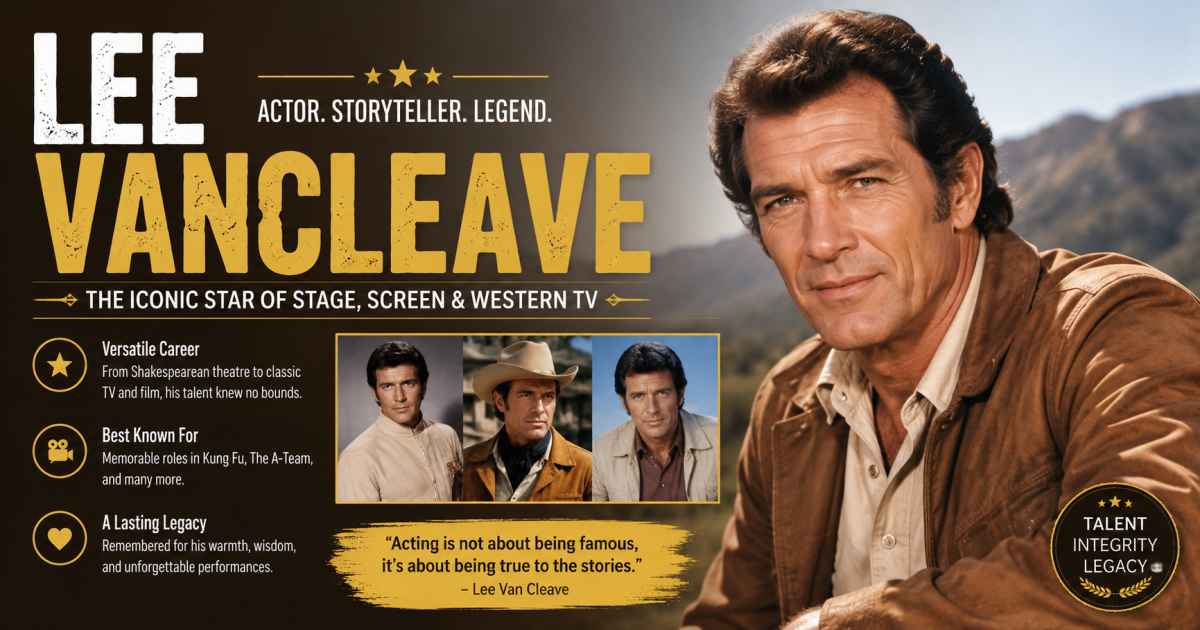
When people search for lee vancleave, they are generally looking for information about the famous American actor Lee Van Cleef, one of the most recognizable faces in classic Western and action cinema. Known for his distinctive appearance, piercing eyes, deep voice, and controlled screen presence, Lee Van Cleef developed a career that stretched across several decades and included Hollywood Westerns, European productions, television programs, action movies, and science-fiction films. Although he was frequently cast as a villain during the early part of his career, his talent and unmistakable presence eventually helped him become an international star. His work with director Sergio Leone, particularly in For a Few Dollars More and The Good, the Bad and the Ugly, transformed him from a familiar supporting actor into one of the defining performers of the spaghetti Western era.
The story behind lee vancleave is particularly interesting because his success did not happen overnight. He began with small roles and spent years appearing as outlaws, criminals, gunfighters, and other intimidating characters before receiving the opportunity that changed his career. He also served in the United States Navy during World War II before entering professional acting. Over time, his unusual appearance, calm manner, and ability to create tension without excessive dialogue became major strengths. Today, Lee Van Cleef is remembered not simply as a Western villain but as an important figure in the history of international genre cinema. His most famous performances continue to attract audiences who appreciate classic Westerns, action movies, and the distinctive filmmaking style associated with Sergio Leone.
Who Was lee vancleave?
Lee Van Cleef, the actor commonly intended by searches for lee vancleave, was an American film and television performer born Clarence LeRoy Van Cleef Jr. on January 9, 1925, in Somerville, New Jersey. He became particularly famous for playing dangerous and morally complex characters, although his career included both villainous and heroic roles. His sharp facial features and intense expression made him immediately recognizable, and filmmakers frequently used those characteristics to create characters who appeared mysterious, powerful, or threatening. His screen identity became so distinctive that even a relatively short appearance could leave a strong impression on audiences.
Van Cleef’s career demonstrates how an actor can turn typecasting into an advantage. During his early years in Hollywood, he was often given villainous supporting parts because of his appearance. Instead of allowing those limitations to end his ambitions, he continued working until a major opportunity arrived in Europe. His role as Colonel Douglas Mortimer in Sergio Leone’s For a Few Dollars More gave him a chance to demonstrate that he could occupy a leading role and share the screen successfully with Clint Eastwood. From that point forward, his career expanded considerably, and he became one of the most recognizable actors associated with the spaghetti Western.
lee vancleave Early Life
Lee Van Cleef grew up in New Jersey and was born into a family of Dutch ancestry. Before entering the entertainment industry, he experienced a very different kind of life from the one audiences would later associate with him. His early adulthood included military service, and his time in the United States Navy during World War II became an important part of his personal history. After the war, he eventually began exploring acting and became involved in theater, which provided an important path toward professional entertainment.
His transition from ordinary civilian life to acting was gradual rather than immediate. Theater helped him develop experience in performance and eventually opened opportunities that led toward film and television. This background is worth remembering because his later image as an effortlessly confident gunslinger can make it seem as though he was always destined for Western movies. In reality, his acting career developed through persistence, smaller opportunities, and years of professional work before he received the roles that made him internationally famous.
lee vancleave and Military Service
Before becoming a movie star, Lee Van Cleef served in the United States Navy during World War II. His military service included work aboard vessels involved in wartime operations, and he returned to civilian life after the conflict. His service is an important part of his biography because it occurred long before the Western roles that made him famous and illustrates the variety of experiences he had before establishing himself as an actor.
Although his military background should not be treated as a direct explanation for his later screen characters, it is interesting to compare this part of his life with the authority and discipline he often projected on screen. Many of his characters appeared confident in dangerous situations, and his restrained acting style gave them an experienced quality. His military service was only one part of his life, but it preceded the theatrical and cinematic career that eventually made his name famous.
lee vancleave Begins His Acting Career
Lee Van Cleef entered professional acting through theater before moving into film. His screen debut came in the classic Western High Noon in 1952. Although the role was small, appearing in such a major production gave him an important beginning in Hollywood. He subsequently worked steadily in films and television, especially in Westerns and crime productions, where he frequently played villains, outlaws, and other tough characters.
The early stage of his career was characterized by supporting roles rather than leading parts. He became a familiar face to viewers, but Hollywood did not initially treat him as a major star. His unusual appearance helped him secure work but also contributed to typecasting. For many years, he was primarily considered a character actor who could convincingly portray a dangerous man. His eventual international success was therefore a significant change in his professional status.
lee vancleave and High Noon
High Noon, released in 1952, occupies an important position in the story of lee vancleave because it was his major film debut. The movie starred Gary Cooper and became one of the most respected Westerns in American film history. Van Cleef appeared as Jack Colby, one of the outlaws connected with the threat facing the film’s protagonist.
While the part was small, High Noon gave Van Cleef an early association with the Western genre that would later define much of his career. Over the following years, he continued appearing in Western films and television productions, gradually developing the screen identity that would eventually make him ideal for the European Westerns of the 1960s. His early work may not have made him a household name immediately, but it established the foundation for the career that followed.
lee vancleave and Western Movies
Western cinema became the most important genre in Lee Van Cleef’s career. During the 1950s and early 1960s, he appeared in numerous Western films and television programs, usually as a villain, outlaw, gunfighter, or other intimidating character. His appearance was particularly suited to the genre because Western storytelling often relies on strong visual distinctions between heroes and antagonists. Van Cleef could communicate danger through a glance or a quiet expression, making him an effective presence even when he had relatively little dialogue.
His association with Westerns eventually extended beyond traditional Hollywood productions. European filmmakers were developing a new style of Western during the 1960s, and Van Cleef became one of the performers who helped establish that style internationally. These movies often featured morally ambiguous characters, stylized violence, dramatic close-ups, memorable music, and a more visually elaborate approach than many traditional American Westerns. Van Cleef’s screen persona fit this new cinematic environment exceptionally well.
lee vancleave and Sergio Leone
One of the greatest turning points in lee vancleave history came when director Sergio Leone cast him in For a Few Dollars More. Released in 1965, the movie starred Clint Eastwood and Lee Van Cleef, with Van Cleef playing Colonel Douglas Mortimer. The role gave him an opportunity to move beyond the small villainous parts that had characterized much of his earlier career.
The partnership with Sergio Leone was extremely important because Leone understood how to use Van Cleef’s physical appearance and restrained performance style. Long close-ups, dramatic pauses, and carefully constructed confrontations allowed the actor’s expression to become part of the storytelling. Rather than needing elaborate dialogue to establish a character, Van Cleef could communicate confidence and danger simply by looking at another character. His collaboration with Leone helped turn these qualities into major cinematic strengths.
lee vancleave in For a Few Dollars More
For a Few Dollars More is one of the most important films in the career of Lee Van Cleef. In the movie, he plays Colonel Douglas Mortimer, a bounty hunter whose motivations are gradually revealed as the story progresses. Clint Eastwood plays another bounty hunter, and the relationship between the two characters forms a major part of the film’s appeal.
The performance was important because it demonstrated that Van Cleef could play more than a one-dimensional villain. Mortimer is skilled, intelligent, determined, and driven by personal motives. Van Cleef’s controlled performance gives the character authority without making him unnecessarily theatrical. The film’s success helped establish him as an international star and demonstrated that audiences were willing to see him in a much larger role.
lee vancleave in The Good, the Bad and the Ugly
For many people searching for lee vancleave, The Good, the Bad and the Ugly is the movie most closely associated with the actor. Released in 1966 and directed by Sergio Leone, the film featured Clint Eastwood as Blondie, Eli Wallach as Tuco, and Lee Van Cleef as Angel Eyes. Van Cleef’s character is a ruthless and calculating gunslinger whose presence creates much of the film’s tension.
Angel Eyes became one of the most recognizable villains in Western cinema. Van Cleef’s performance relies heavily on his controlled expression and intimidating screen presence rather than constant displays of emotion. Leone’s use of extreme close-ups makes the actor’s eyes and facial expressions especially important. The result is a character who can appear threatening even when he is simply standing still. This performance cemented Van Cleef’s reputation and helped ensure that his name would remain connected with classic Western cinema for generations.
Why lee vancleave Was So Effective as a Villain
The effectiveness of Lee Van Cleef’s villainous performances came from several elements working together. His facial structure immediately created a distinctive appearance, while his voice gave his characters additional authority. However, perhaps the most important quality was his restraint. Instead of exaggerating every threatening moment, he often allowed silence and small movements to create tension.
This approach worked particularly well in Westerns, where confrontations could be built around long periods of silence followed by sudden action. Van Cleef could look at another character and create the impression that he was already planning his next move. This understated style made his villains feel intelligent and deliberate rather than simply angry. As a result, audiences could remember his characters long after the movie ended.
lee vancleave Movies Beyond Sergio Leone
Although Sergio Leone’s films are the most famous part of his career, lee vancleave appeared in many other movies. His filmography included productions such as The Big Gundown, Death Rides a Horse, Day of Anger, Sabata, Barquero, El Condor, and The Grand Duel. These films helped establish him as one of the major stars of European Western cinema.
His work during this period demonstrated that he could play different variations of the tough Western character. Sometimes he was a villain, sometimes a hero, and sometimes an ambiguous figure whose motivations were somewhere between the two. This flexibility helped him remain popular even as the Western genre changed. His international career also meant that his work reached audiences far beyond the United States.
lee vancleave and Action Movies
As the popularity of the classic Western declined, Lee Van Cleef increasingly moved into action and adventure films. His established reputation made this transition relatively natural because audiences already associated him with physical toughness and dangerous characters. He appeared in productions that combined Western influences with martial arts, crime, adventure, and other action genres.
This stage of his career showed that his appeal was not limited to the traditional cowboy setting. His distinctive appearance could work just as effectively in a modern city, futuristic environment, or martial-arts story. He remained recognizable even when the surrounding genre changed, which is one reason his career continued for so many years.
lee vancleave in Escape from New York
One of Lee Van Cleef’s notable later film appearances came in John Carpenter’s Escape from New York, released in 1981. The film starred Kurt Russell as Snake Plissken and presented a dystopian version of Manhattan that had been transformed into a massive prison. Van Cleef played Hauk, the police commissioner who sends Plissken on his dangerous mission.
The role was different from his classic Western characters, but his established screen persona remained valuable. Hauk is authoritative, serious, and intimidating, qualities that Van Cleef had spent decades developing through his earlier work. His appearance in the movie also introduced him to audiences who might not have been familiar with his Western filmography, helping extend his influence into a new generation of genre cinema.
lee vancleave on Television
Lee Van Cleef also worked extensively in television. During his career, he appeared in numerous television programs and eventually took a leading role in the 1984 action series The Master. The series featured Van Cleef as John Peter McAllister, an experienced martial artist who becomes involved in an adventure involving his former student.
Television provided another opportunity for Van Cleef to demonstrate his versatility. Although he is remembered primarily for movies, his television work was an important part of his professional life. It also illustrates how his popularity extended beyond the Western genre and into the broader action and adventure market.
lee vancleave Acting Style
The acting style associated with lee vancleave can best be described as controlled, economical, and visually expressive. He did not need excessive movement or dramatic speeches to dominate a scene. Instead, he often relied on his eyes, posture, voice, and timing. Directors could place the camera close to his face and allow his expression to communicate what another actor might have conveyed through extensive dialogue.
This style became particularly effective in the films of Sergio Leone. Leone’s filmmaking frequently emphasized faces, eyes, silence, and anticipation before major confrontations. Van Cleef’s ability to remain still while projecting a sense of danger fit perfectly into this approach. His performances therefore became more than simple portrayals of villains; they became part of the visual identity of the spaghetti Western itself.
lee vancleave Career Challenges
Van Cleef’s career included significant challenges before his international success. His early Hollywood work often placed him in repetitive villainous roles, and his distinctive appearance made it difficult for casting directors to imagine him in conventional romantic or heroic roles. He also experienced a serious automobile accident in 1959 that resulted in a severe knee injury and temporarily threatened his ability to continue working in the same way.
The turning point came during a period when his Hollywood career had slowed. He was considering other interests when Sergio Leone offered him the role in For a Few Dollars More. That opportunity demonstrated how dramatically one role can change an actor’s professional life. Instead of remaining a familiar supporting performer, Van Cleef became a major international star whose name would become permanently associated with Western cinema.
lee vancleave and His Most Famous Characters
Among Van Cleef’s many characters, Colonel Douglas Mortimer and Angel Eyes stand out above the rest. Mortimer represented a more heroic and morally complex side of the actor, while Angel Eyes became the embodiment of his cold and calculating villain persona. Together, these performances demonstrate the range available within his screen image.
His other characters also contributed to his reputation. Whether he was playing a gunfighter, bounty hunter, military figure, police official, or criminal, he brought a consistent sense of authority and seriousness to the role. This consistency made him highly recognizable while still allowing individual characters to feel different.
lee vancleave Legacy
The legacy of lee vancleave is inseparable from the correct name Lee Van Cleef and from the history of the Western genre. His performances helped define the visual language of the spaghetti Western and influenced how later filmmakers portrayed gunslingers, villains, antiheroes, and morally ambiguous characters.
His influence extends beyond the movies he personally made. The image of the quiet, intimidating gunslinger with a piercing stare has become a familiar archetype throughout popular culture. Actors, filmmakers, television producers, and video-game creators have repeatedly drawn upon similar character types. Van Cleef’s performances remain powerful because they demonstrate how much an actor can communicate through presence alone.
lee vancleave Death and Final Years
Lee Van Cleef died on December 16, 1989, in Oxnard, California, at the age of 64. His death brought an end to a career that had lasted nearly four decades. During that time, he had moved from small supporting roles in American Westerns to major parts in internationally successful films and later action and television productions.
Although his life ended relatively early, his cinematic legacy continued. His most famous movies remained popular with Western enthusiasts and classic-film audiences, and his performances continued to introduce new viewers to the style of Sergio Leone and the broader spaghetti Western movement. His career is therefore remembered not simply for its length but for the remarkable transformation that occurred during its most successful period.
Best lee vancleave Movies to Watch
For viewers discovering lee vancleave for the first time, For a Few Dollars More is an excellent starting point because it shows the actor in one of his most important leading roles. The film demonstrates his ability to play a sophisticated and determined character while working opposite Clint Eastwood. It also provides a strong introduction to Sergio Leone’s distinctive approach to Western filmmaking.
The Good, the Bad and the Ugly should also be considered essential viewing because Angel Eyes remains one of Van Cleef’s most famous characters. Viewers interested in exploring his wider Western career can then move on to Death Rides a Horse, The Big Gundown, Day of Anger, Sabata, and The Grand Duel. For something outside the Western genre, Escape from New York provides an interesting example of his later action-film work.
Frequently Asked Questions About lee vancleave
Who was lee vancleave?
The name lee vancleave is commonly used in searches for Lee Van Cleef, the American actor famous for Westerns, action films, and television. He became internationally recognized for his performances in Sergio Leone’s movies.
What is lee vancleave best known for?
lee vancleave is best known for the actor Lee Van Cleef’s roles in For a Few Dollars More and The Good, the Bad and the Ugly. His performances as Colonel Douglas Mortimer and Angel Eyes are particularly famous.
What was Lee Van Cleef’s real name?
Lee Van Cleef was born Clarence LeRoy Van Cleef Jr. on January 9, 1925, in Somerville, New Jersey.
Was lee vancleave in The Good, the Bad and the Ugly?
Yes. Lee Van Cleef played Angel Eyes in The Good, the Bad and the Ugly, directed by Sergio Leone and released in 1966.
Was lee vancleave in For a Few Dollars More?
Yes. Lee Van Cleef played Colonel Douglas Mortimer in For a Few Dollars More, appearing alongside Clint Eastwood.
Was lee vancleave in High Noon?
Yes. Lee Van Cleef appeared in High Noon in 1952 as Jack Colby. The film was an important early credit in his acting career.
What are the best lee vancleave movies?
Some of the best-known Lee Van Cleef movies include For a Few Dollars More, The Good, the Bad and the Ugly, Death Rides a Horse, The Big Gundown, Day of Anger, Sabata, The Grand Duel, and Escape from New York.
Did lee vancleave serve in the military?
Yes. Lee Van Cleef served in the United States Navy during World War II before establishing his acting career.
Was lee vancleave always a villain?
No. Although he was frequently cast as a villain, he also played heroes, antiheroes, bounty hunters, military figures, and morally complex characters. Colonel Douglas Mortimer is one of the clearest examples of a major role that moved beyond his traditional villain image.
Who directed Lee Van Cleef in his most famous Westerns?
Sergio Leone directed Lee Van Cleef in For a Few Dollars More and The Good, the Bad and the Ugly. These films played a major role in establishing Van Cleef as an international Western star.
Was lee vancleave in Escape from New York?
Yes. Lee Van Cleef played Hauk, the police commissioner, in John Carpenter’s 1981 science-fiction action film Escape from New York.
When did lee vancleave die?
Lee Van Cleef died on December 16, 1989, at the age of 64.
How old was lee vancleave when he died?
Lee Van Cleef was 64 years old when he died in 1989.
Why is lee vancleave still famous?
His enduring popularity comes from his distinctive appearance, memorable performances, and association with some of the most influential Western films ever made. His work with Sergio Leone, especially The Good, the Bad and the Ugly, helped establish him as an iconic figure in international cinema.
Conclusion
The story of lee vancleave, referring to the actor correctly known as Lee Van Cleef, is one of perseverance, transformation, and remarkable cinematic influence. His career began with small supporting roles and years of playing villains before a major opportunity with Sergio Leone changed his professional direction. His performances in For a Few Dollars More and The Good, the Bad and the Ugly demonstrated that the qualities that once limited him to supporting roles could instead make him an international star.
Lee Van Cleef’s legacy continues because his performances remain visually and emotionally memorable. He helped define the image of the intelligent, dangerous gunslinger and became one of the most important faces of the spaghetti Western. Yet his career was broader than those films alone, extending into television, action movies, science fiction, and other genres. For anyone searching for lee vancleave, exploring his biography and filmography provides an opportunity to discover not only a remarkable actor but also an important chapter in the development of modern Western and action cinema.